
Navigating the vibrant and diverse landscape of Spain is more than just a journey across stunning scenery; it’s an exploration of a complex and fascinating political structure. The country is not simply one monolithic entity but a rich mosaic woven from 17 autonomous communities and two autonomous cities, each pulsating with its own unique culture, history, and identity. Within these larger regions lie the 50 provinces, the foundational building blocks that define local governance and daily life. Understanding this framework is the key to unlocking the true essence of Spain, from the sun-drenched coasts of Andalusia to the green, rolling hills of the Basque Country. Each province, with its designated capital, tells a story, contributing a distinct chapter to the grand narrative of the nation. This administrative map is the secret code to appreciating Spain’s profound regional diversity.
- Spain is divided into 17 autonomous communities and 2 autonomous cities (Ceuta and Melilla).
- These communities are further subdivided into a total of 50 provinces.
- Most provinces are named after their capital city, a tradition that simplifies geography but has notable exceptions.
- Seven autonomous communities consist of a single province.
- The structure allows for a high degree of regional self-governance, contributing to Spain’s cultural richness.
Understanding Spain’s Administrative Puzzle: Communities vs. Provinces
At first glance, the distinction between an autonomous community and a province might seem confusing. Think of it as a two-tiered system designed to balance national unity with regional autonomy. The autonomous communities are the highest-level administrative divisions. They function like states in a federal system, with their own elected parliaments, governments, and significant legislative powers over areas like education, health, and culture.
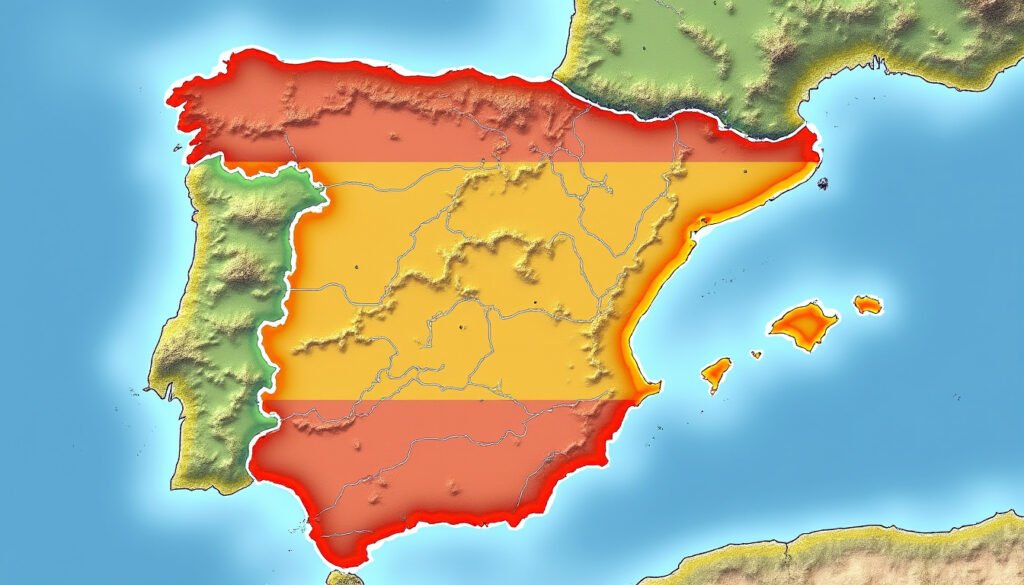
The provinces, on the other hand, are territorial divisions within these communities. Established in 1833, they primarily serve as the basis for electoral constituencies, local government administration, and statistical data collection. While the communities celebrate regional identity, the provinces ground it in a specific geographic and administrative reality. A great way to visualize this is through a detailed administrative map of Spain that shows these layers.
A Journey Through Spain’s Communities and Their Provinces
To truly grasp the layout of the country, the best approach is to travel region by region. Each autonomous community has a distinct character, reflected in the provinces it contains. Some communities are sprawling giants composed of many provinces, while others are small and unified, consisting of just one.
Andalusia: The Heart of the South
As the most populous and second-largest community, Andalusia is a quintessential vision of Spain for many. It is composed of eight provinces, each offering a different flavor of southern Spanish life:
- Almería
- Cádiz
- Córdoba
- Granada
- Huelva
- Jaén
- Málaga
- Seville (The community’s capital)
Castile and León: A Historic Giant
To the north of Madrid lies the largest autonomous community in Spain, Castile and León. A land of castles, cathedrals, and vast plains, it is divided into nine provinces, the most of any community:
- Ávila
- Burgos
- León
- Palencia
- Salamanca
- Segovia
- Soria
- Valladolid (The community’s capital)
- Zamora
Catalonia: A Distinct Coastal Identity
In the northeastern corner of Spain, Catalonia boasts a strong cultural identity and a stunning Mediterranean coastline. It is structured into four provinces, with its world-famous capital leading the way.
- Barcelona (The community’s capital)
- Gerona (Girona)
- Lérida (Lleida)
- Tarragona
The Single-Province Communities: A Unique Status
A unique feature of Spain’s organization is the group of seven communities that consist of just a single province. In these cases, the community and the province share the same territory and often the same name. This structure simplifies governance while preserving a strong regional identity. The single-province communities are:
- Asturias
- Balearic Islands
- Cantabria
- La Rioja
- Madrid
- Murcia
- Navarre
For a complete breakdown, you can explore a list of Spanish provinces and their capitals to see how these regions fit into the larger picture.
The Complete Provincial Roster
Beyond the regions highlighted, Spain’s remaining communities contribute their own essential pieces to the national puzzle. From the rugged Basque Country to the fertile lands of Valencia, these regions and their provinces are vital to the country’s fabric.
Here is the distribution for the other communities:
- Aragon: Huesca, Teruel, Zaragoza
- Basque Country: Álava, Guipúzcoa, Vizcaya
- Canary Islands: Santa Cruz de Tenerife, Las Palmas
- Castile-La Mancha: Albacete, Ciudad Real, Cuenca, Guadalajara, Toledo
- Extremadura: Badajoz, Cáceres
- Galicia: La Coruña, Lugo, Orense, Pontevedra
- Valencia: Alicante, Castellón, Valencia
The Curious Case of Capitals and Naming Conventions
A fascinating quirk in the Spanish system is the relationship between the names of provinces and their capitals. In most cases, the system is straightforward: the province of Seville has the capital city of Seville. However, there are exceptions that reveal deeper historical and political layers.
For instance, some provinces in the Basque Country have official names in both Spanish and Basque, like Álava, whose capital is Vitoria-Gasteiz. The most notable exceptions are the capitals of the autonomous communities themselves. Two cities hold the prestigious title of being a community’s capital without being the capital of a province: Mérida is the capital of Extremadura (the provincial capitals are Cáceres and Badajoz), and Santiago de Compostela is the capital of Galicia (the provincial capitals are La Coruña, Lugo, Orense, and Pontevedra).
How many provinces does Spain have in total?
Spain is divided into exactly 50 provinces. These provinces are distributed among the 17 autonomous communities.
What is the difference between an autonomous community and a province?
An autonomous community is a first-level political division with its own government and legislative powers, similar to a state. A province is a smaller territorial division within a community, mainly for administrative and electoral purposes.
Are all autonomous communities made up of multiple provinces?
No, seven of Spain’s 17 autonomous communities consist of a single province. These are Asturias, the Balearic Islands, Cantabria, La Rioja, Madrid, Murcia, and Navarre.
Are Ceuta and Melilla considered provinces?
No, Ceuta and Melilla are not provinces. They hold a unique status as autonomous cities, giving them a level of self-governance that is higher than a municipality but different from an autonomous community.